Are dogs allowed on trains in the UK and Europe?
Yes, dogs are allowed on many trains in Great Britain and parts of Europe, but the answer changes by route, operator and border crossing. The easy part is often the local rail leg. The harder question is whether your full route, documents and dog’s welfare all hold together.
Most weak plans start with a half-true assumption: dogs on trains UK rules are fairly permissive, so the rest of the route must be workable too. National Rail allows passengers in Great Britain to take up to two pets at no extra charge, provided dogs are kept on a lead or in a carrier and animals stay off seats.
That rule does not solve a UK to Europe with a dog by train plan. Once you add Eurostar, a Channel crossing, onward connections, documents, a large dog or more than one pet, you are dealing with route feasibility rather than simple train permission.

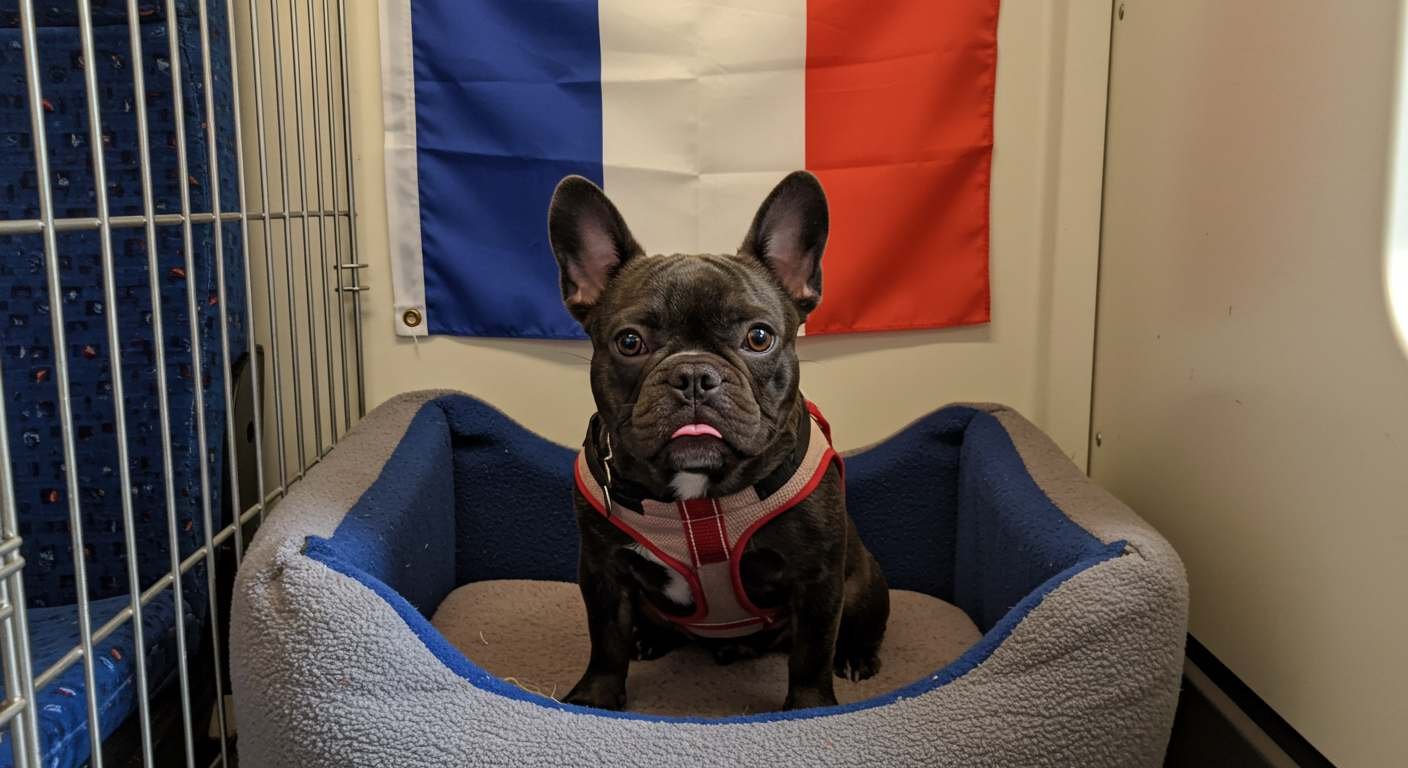
A photo of a French Bulldog – One of the most popular companion dogs. Friendly, playful, and adaptable to apartment living.
Here's What We Have Covered In This Article
The UK to Europe rail plan often breaks at the Channel crossing
A dog can be allowed on a domestic train to reach an international station, then be refused on the international leg. That is the point many owners miss, because the route looks simple on a booking screen and fails when operator rules are applied.
Domestic rail is usually the easy leg
A short rail trip inside Great Britain is usually the least complicated part. Train operating companies still have rules, and busy services can make the trip less suitable for some dogs, but the basic permission is clear enough for many ordinary routes.
Our concern starts when that domestic leg becomes the first piece of a longer move. A dog travelling calmly for one stop is a different matter from a dog being moved through stations, handovers, border checks and onward rail connections.
Eurostar is the common blocker
Eurostar is where the casual “can dogs travel by train” answer becomes misleading. Ordinary pets are not allowed on Eurostar trains to and from London, and Eurostar also excludes pets on some other named services. Guide dogs and assistance dogs are treated differently, with Eurostar requiring contact at least 24 hours before travel for an eligible guide or assistance dog or cat.
That distinction matters. A pet dog, an assistance dog and an emotional support animal are not interchangeable categories for travel purposes. If your plan depends on boarding Eurostar from the United Kingdom with an ordinary dog, the rail plan has already hit its main obstacle.
When our pet travel team reviews cross-Channel routes, we look at the whole route rather than the first train you can book. The question is not whether one leg accepts dogs. The question is whether the dog can legally and practically move through every handover point.
Crossings usually need another route
Eurotunnel Le Shuttle, ferry operators, flights or managed pet transport may become the realistic alternatives once Eurostar is ruled out for an ordinary pet. None of those options should be treated as automatic, because each has its own booking conditions and suitability issues.
A workable plan starts with the crossing, then builds the rail or road legs around it. If you reverse that order, owners often end up with valid train tickets and no acceptable way to move the dog across the Channel.
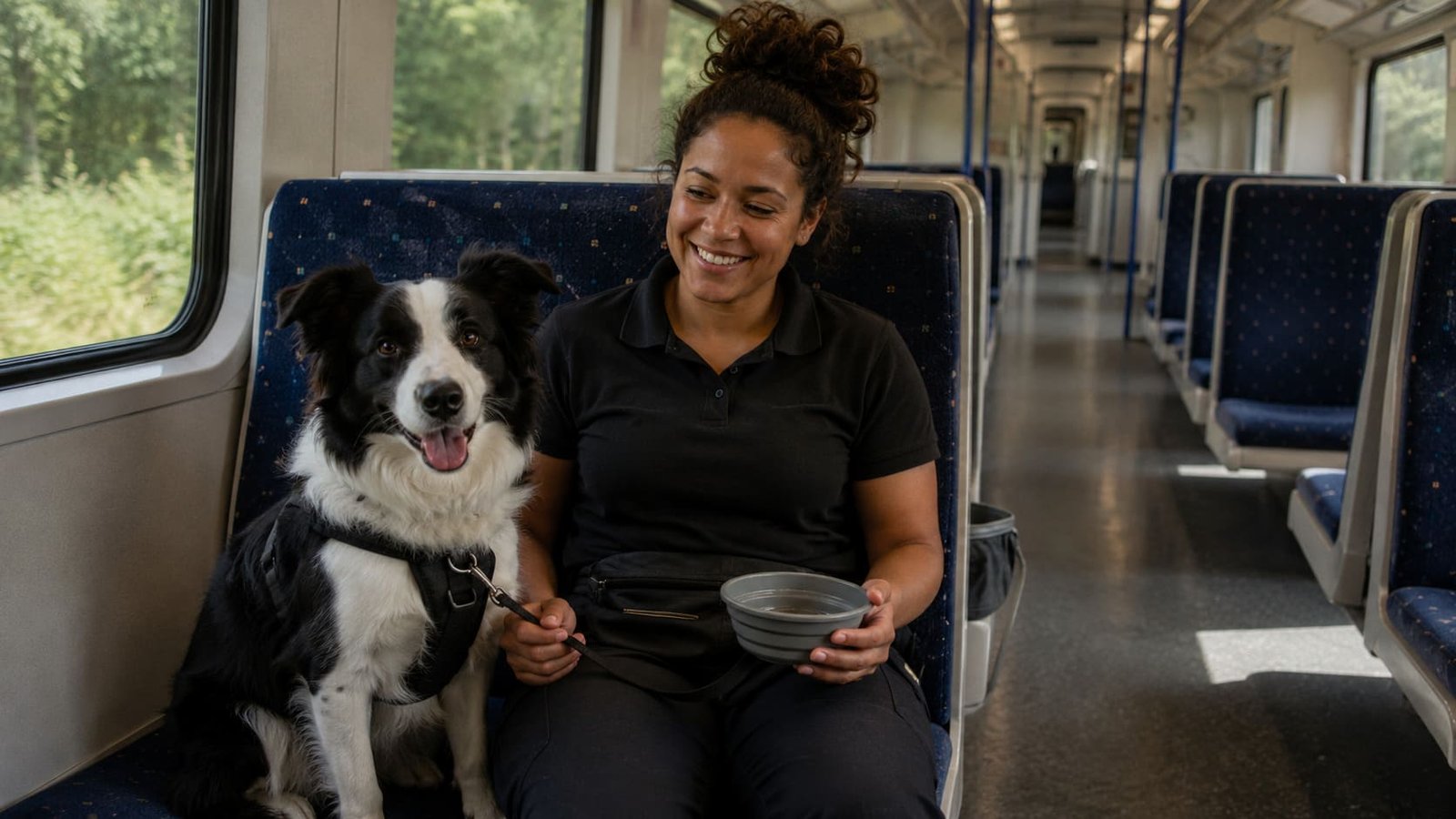
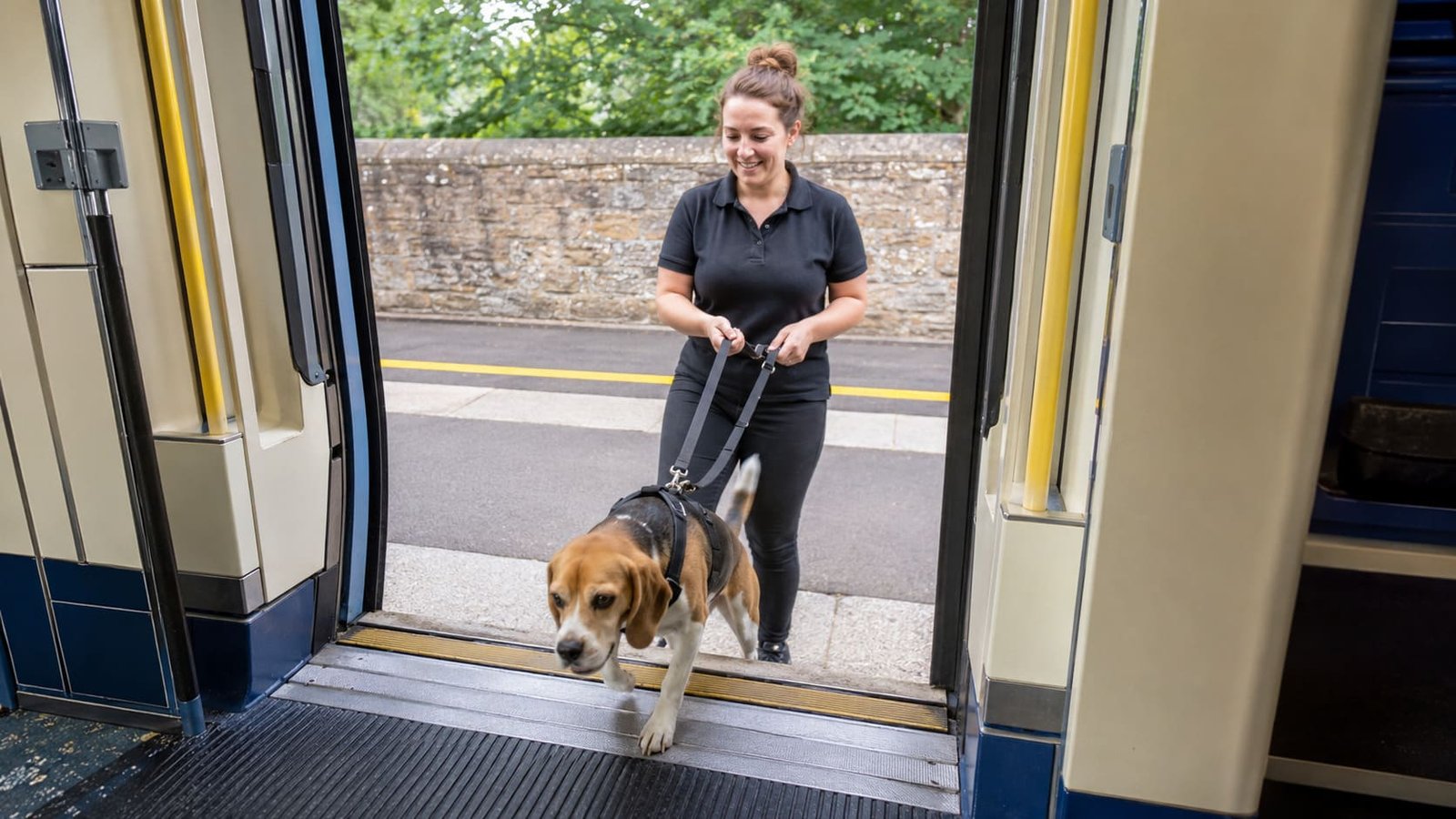
Pet travel handler sits with a harnessed dog aboard a train.
European rail rules are a patchwork, not one dog-friendly system
Dogs on trains Europe rules vary by operator, route, dog size and service type. “Europe is dog-friendly” is too vague to trust with a serious move, because acceptance on one continental route does not prove acceptance on the route you need.
Eurostar’s eligible continental routes show how specific the rules can be. On routes between Belgium, France, Germany and the Netherlands where pets are accepted, small domestic animals under 6 kg can travel free in a carrier no larger than 45 cm x 30 cm x 25 cm, while larger dogs need a €30 dog fare and must be leashed and muzzled.
For other European train operating companies, we would expect the practical questions to turn on details such as:
- Dog size and carrier fit, especially where a small-dog rule is written around the carrier rather than the animal alone.
- Lead and muzzle requirements, which matter only if your dog can cope with them for the real length of the trip.
- Ticket type or dog fare rules, since acceptance can depend on how the dog is booked as well as whether pets are mentioned.
- Train changes and station time. A route with several transfers gives more chances for confusion, delay or refusal.
Large dogs need particular care in the planning. A rule that permits a muzzled dog on the floor still leaves practical questions about space, crowding, station changes and whether the dog is settled enough for the route. The permission is useful, but it is not a welfare assessment.
Paperwork rules and train rules are separate gates
Can the train accept your dog and the border still refuse the move? Yes. Operator permission and pet travel documents are separate issues, and one does not fix the other.
For travel from Great Britain into the European Union, EU, old advice about pet passports can cause real problems. GOV.UK says that from 22 April 2026, new EU rules affected non-commercial movements of dogs, cats and ferrets by GB residents, and GB residents should now expect to use an Animal Health Certificate, usually shortened to AHC, rather than relying on an EU pet passport for travel from Great Britain to an EU country.
An AHC is not a reusable pass for repeated outward trips from Great Britain. GOV.UK says it remains single-use for travel from Great Britain to the EU, even though it can cover onward travel within the EU and re-entry to Great Britain for a longer period when the rabies vaccination remains valid.
Assistance dog status also needs careful handling. A train operator may make a different allowance for an assistance dog, but border documentation still has to match the movement, the owner’s timing and the route. For a serious relocation or time-sensitive trip, paperwork and operator rules need to be checked together, not treated as two separate admin jobs.

Pet travel handler reviews documents beside a calm harnessed dog indoors.
The safest option depends on the whole route, not the nicest idea
When the route becomes more complex, the best option is the one that reduces refusal, delay and welfare risk across the full trip. A train may be right for a simple domestic route, but a large dog, multiple pets, unclear documents or a Channel crossing can change the answer quickly.
| Option | Where it can work | Where it becomes risky |
|---|---|---|
| Domestic train in Great Britain | Shorter trips with a settled dog and clear operator rules | Crowded services, anxious dogs or awkward onward links |
| Continental rail | Routes where the operator accepts your dog’s size and booking type | Large dogs, muzzle issues, tight transfers or unclear ticket rules |
| Eurotunnel Le Shuttle or ferry | Cross-Channel plans where the booking route accepts pets | Assuming acceptance without matching the pet, passenger and route |
| Flight | Longer international moves where rail would create too many handovers | Dogs with welfare concerns, unsuitable timings or document uncertainty |
| Managed pet transport | Cross-border, time-sensitive or high-risk moves needing oversight | Poor fit only where the trip is simple enough for ordinary owner travel |
Welfare is the part that gets underplayed. Water and a lead are basic, but they do not answer whether your dog can cope with long station waits, noise, heat, repeated transfers, medical needs or age-related limits. A calm dog on a quiet domestic train can become a different traveller after several legs and a border crossing.
For our pet travel team, the safest route is the one where compliance, timing and welfare are assessed together before the plan is fixed. That matters more now because route-specific pet acceptance and the April 2026 document changes have made older online advice less reliable. Over the next 12 to 24 months, current operator rules and current GB-to-EU paperwork will matter more than any general claim that dogs are allowed on trains.
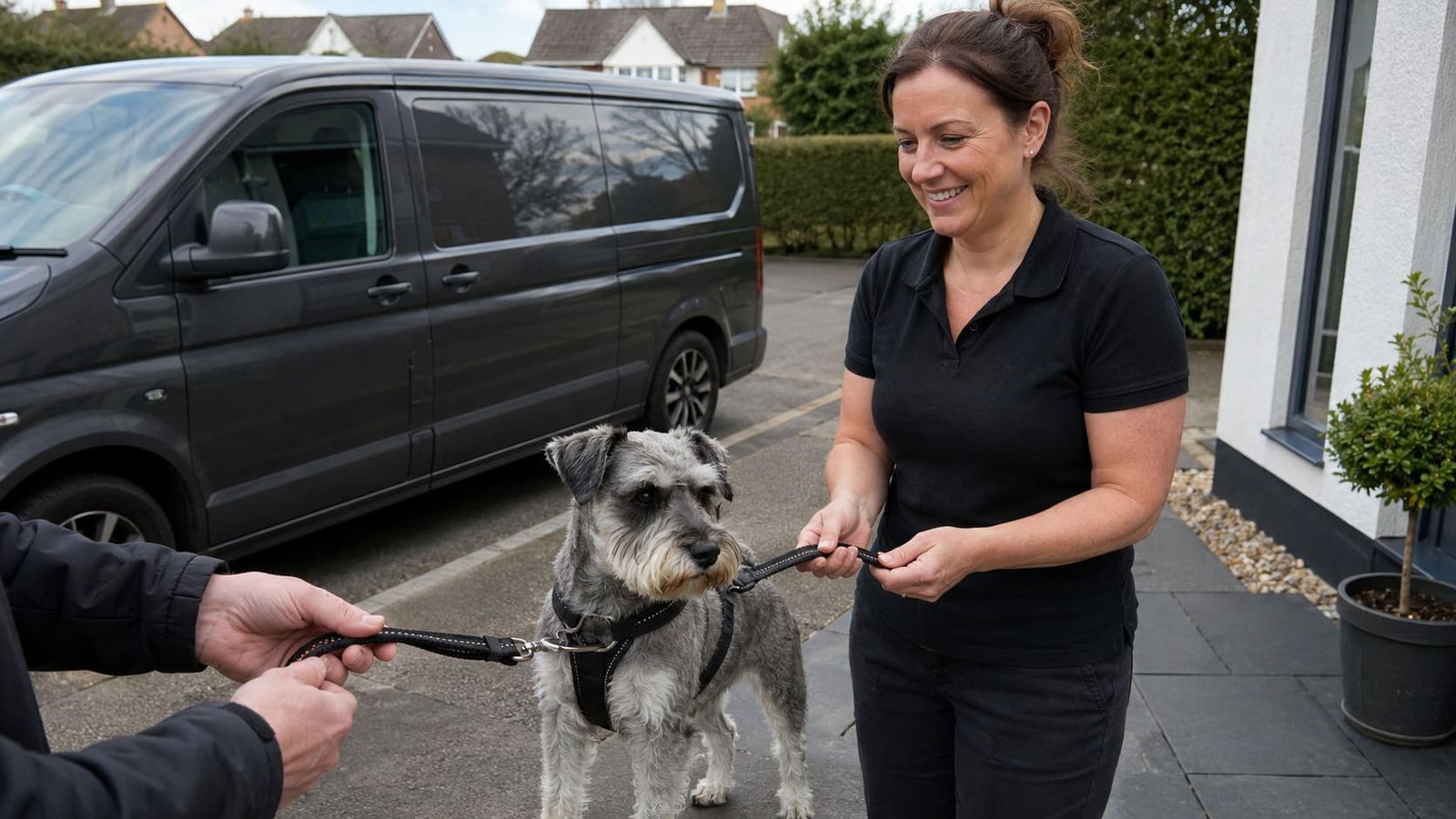
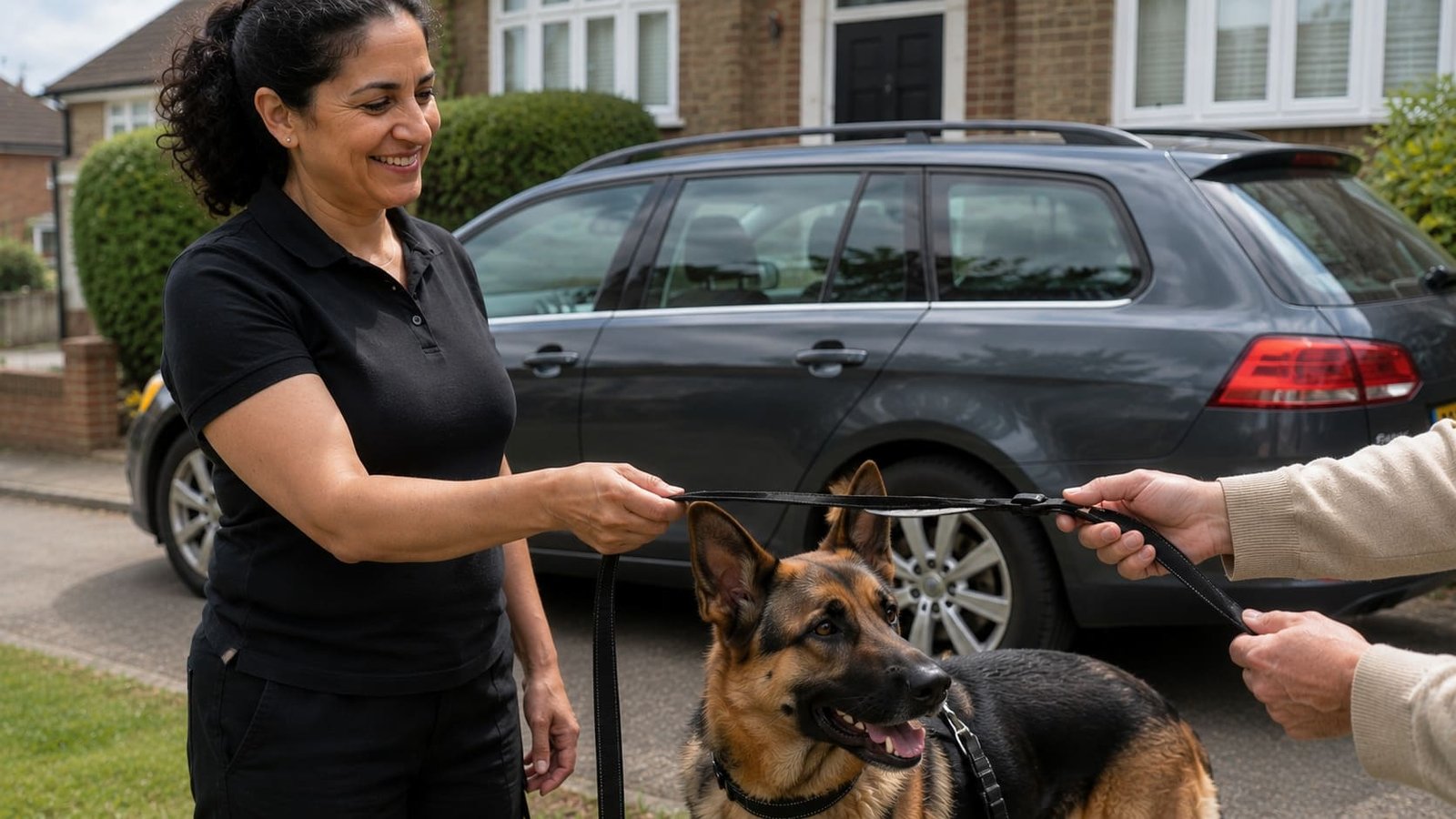
Pet travel handler receives a harnessed dog during a home handover.
Questions we get asked about dogs on trains and cross-border pet travel
Can my dog travel in a carrier for the whole rail route?
A carrier helps only where the operator accepts that carrier size and your dog can remain safely inside it for the trip. Carrier permission on one train does not prove the same arrangement works across every connection.
Do emotional support animals have the same status as assistance dogs on Eurostar?
No. Eurostar’s pet rules distinguish ordinary pets from guide dogs and assistance dogs, and emotional support animals should not be assumed to have the same travel status.
Can sleeper trains work for dogs in Great Britain?
National Rail allows pets on sleeper trains, but animals are not allowed in restaurant cars except assistance dogs, and a cleaning charge can apply for dogs unless they are assistance animals. Suitability still depends on your dog and the service booked.
What makes a large dog harder to move by train in Europe?
Large dogs are harder because rules may involve a fare, a lead, a muzzle and floor space rather than a simple carrier. The practical test is whether your dog can cope with those conditions for the actual route.
Are ferries or Eurotunnel Le Shuttle automatically safer than rail?
No option is automatic. Ferries and Eurotunnel Le Shuttle can be useful alternatives when Eurostar is not available for an ordinary pet, but the booking, route and welfare fit still need to be right.
This is general information, not professional advice.