Is your dog allowed to travel from Britain to Switzerland?
Yes, your dog can travel from Britain to Switzerland, provided the microchip, rabies vaccination, Animal Health Certificate and route all match the rules in force. We treat it as one joined-up trip because the dog may pass through the EU, enter Switzerland, and later re-enter Great Britain.
Switzerland sits outside the EU, although its pet travel rules are closely aligned with EU-style requirements for dogs, cats and ferrets. That small distinction matters. A route through France is different from a direct flight into Switzerland, and a holiday is different from a permanent move.
An Animal Health Certificate is only one part of the decision. We also look at where the dog first enters Europe, how Swiss customs will be handled, and whether the return to Great Britain has been planned.
Older advice online can make this look like a simple document question. The safer question is whether the dog, the paperwork and the route all match on the day of travel.
Dog Paw Care Before International Pet Travel – Illustrative Image
Here's What We Have Covered In This Article
Paperwork timing decides whether the journey holds
Paperwork is usually where a planned Switzerland trip first becomes fragile. A valid-looking Animal Health Certificate for Switzerland can still fail if the rabies date, microchip record or certificate issue date does not support the route.
As of 8 September 2026, GOV.UK says an Animal Health Certificate must be issued before entry to the EU and is valid for entry within 10 days of issue. Day 1 is the date the certificate is issued. That matters for a UK dog to Switzerland rules check because many owners plan the ferry, Eurotunnel crossing or flight first, then find the certificate window is tighter than the travel plan.
Rabies timing creates the next pressure point. A first rabies vaccination must be at least 21 full days old before travel, with Day 1 counted as the day after vaccination. The dog must be microchipped before, or at the same time as, that rabies vaccination. If the chip came later, the rabies record can stop working for travel.
A normal vet appointment is not always enough. The Animal Health Certificate must be signed by an Official Veterinarian, meaning a vet authorised to issue that document. Vet availability, certificate issue date and route timing need to line up before the pet travel certificate protects the move.
The certificate protects the journey when the dates match the route, not when the form merely exists. Tailored Pet Travel checks certificate timing alongside the route because one wrong date can turn a planned movement into a refused booking, a delayed departure or a changed border plan.
Can a UK dog travel by road through France?
Yes, a UK dog can travel by road through France to Switzerland, but that route brings two separate entry points into play. The dog may enter the EU first, then Switzerland later, so the paperwork and customs plan must cover both stages.
Road through France
A road trip via France is common because the dog first reaches the EU before the Swiss border. Switzerland then has its own entry position. FSVO guidance distinguishes entry into Switzerland from the EU and entry from third countries, so the route is judged by where the animal is coming from when it reaches Switzerland.
A road journey to Switzerland is a route planning job, not a simple drive across Europe. The shortest line on a map is less useful than the crossing that matches the certificate, the dog’s status and the customs route into Switzerland.
Swiss customs guidance says pets must be imported via a manned customs office during tourist traffic clearance times, with the animal presented personally and the necessary forms available. For dog border checks Switzerland side, that means the chosen crossing and arrival time matter.
Direct flight into Switzerland
Direct air entry removes the road through France, but it brings its own controls. FSVO says an entry control must always be carried out when entering Switzerland from third countries, and the animal must be presented at the red customs exit.
Flight planning also depends on how the dog travels. Air transport has welfare and acceptance rules, including IATA live animal air transport requirements where they apply. We look at direct flights as a customs and welfare question first, then as a transport choice.
Poodle Drinking Water on International Dog Journey – Illustrative Image
The return to Great Britain needs its own plan
Getting into Switzerland is only half the practical risk if your dog is coming home. The Great Britain return rules sit apart from Swiss entry, so a clean outbound trip does not carry the dog back automatically.
GOV.UK says a vet must treat a dog for tapeworm before entry to Great Britain unless the dog is coming directly from Finland, Ireland, Northern Ireland, Malta or Norway. Switzerland is absent from that exemption list. The treatment must be given by a vet no less than 24 hours and no more than 5 days, or 120 hours, before entry to Great Britain.
This is the tapeworm treatment Switzerland to UK owners often miss because they are focused on the outward leg. The rule concerns entry to Great Britain. Swiss entry remains a separate matter.
A delay abroad can push the dog outside the return window. If the rule is missed, GOV.UK states that a dog can be refused entry to Great Britain or put into quarantine. We plan the return around the treatment window, the travel booking and the document check so the last leg has the same control as the first.
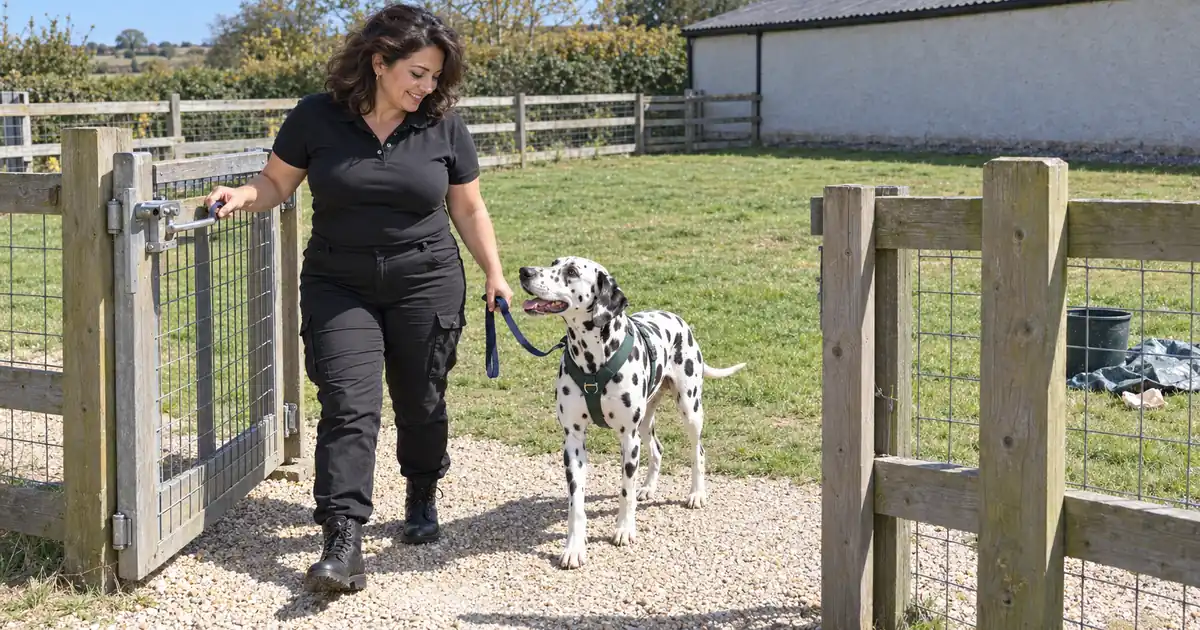
Walking Two Dogs Before Travelling to Switzerland – Illustrative Image
Some Switzerland moves are more than private pet travel
A family relocation, a dog being rehomed, and a dog with cropped ears or a listed breed issue can look similar from a distance. Swiss rules separate those situations, and the purpose of travel can change what needs checking.
FSVO guidance says pet travel rules differ depending on whether you are travelling privately with your own animal or the animal is being imported or exported for transfer to another person or institution. That distinction matters for sale, rescue, rehoming, ownership transfer and some unaccompanied movements.
Situations that need closer checking include:
- Permanent relocation. Moving to Switzerland with a dog continues after arrival because dogs imported from abroad must be registered through a Swiss vet and AMICUS, the Swiss dog registration database.
- Ownership transfer. A dog going to another person or institution may fall outside a normal private pet movement, even if the route looks familiar.
- Docked or cropped dogs. FSVO says importation of dogs with docked ears or docked tails is prohibited, so owners need advice before committing to travel.
- Breed rules. The majority of Swiss cantons have lists of breeds considered dangerous or potentially dangerous, and owners are directed to the Cantonal Veterinary Office for the canton of residence.
- Old paperwork. An EU pet passport deserves its own check, especially where the dog, owner or residence status has changed since it was issued.
Tailored Pet Travel separates ordinary private pet travel from dog relocation to Switzerland, unaccompanied movement and ownership transfer before a route is chosen. That first classification decides whether generic advice fits your dog at all.
Choose the route around the dog and the paperwork
The right route is the one that fits the dog, the dates and the Swiss entry point cleanly. A simple owner-managed trip can work for a straightforward private dog with flexible timing, but tighter cases need closer control.
The table below compares owner-managed road journeys, direct flights and managed pet transport.
| Travel option | Usually suits | Main point to control |
|---|---|---|
| Owner-managed road trip | Straightforward private travel with flexible timing | EU entry, Swiss customs and return planning |
| Direct flight | Suitable dogs where airline acceptance is clear | Swiss arrival control and air travel welfare |
| Managed pet transport | Tight timing, relocation, complex paperwork or sensitive dogs | Joined-up documentation, route and welfare control |
Swiss customs guidance says transport by car, plane or train must be animal friendly and must follow the Swiss Federal Act on the Protection of Animals or IATA rules where relevant. FSVO also allows direct air entry through named Swiss airports, with accompanied dogs travelling in the cabin or as excess luggage and unaccompanied dogs moving under an air waybill.
Once you stop treating Switzerland as one simple European pet trip, the decision becomes clearer. You check the document dates, the first border, the Swiss presentation point, the return plan and the dog’s own status. That changes the question from whether the dog is allowed to go to whether this specific route gives your dog the cleanest chance of travelling without avoidable disruption.
Beagle Veterinary Consultation for UK to Switzerland Dog Travel – Illustrative Image
Questions we get asked about taking dogs to Switzerland
Can one Animal Health Certificate cover more than one pet?
Yes. GOV.UK says one Animal Health Certificate can include up to 5 pets, provided they are eligible to travel together under the relevant rules. Multi-pet travel still needs careful date and route control.
Does my dog need a tapeworm treatment to enter Switzerland?
The UK-sourced tapeworm rule covered here applies to entry to Great Britain. If your dog is returning from Switzerland to Great Britain, that return requirement needs its own planning.
Can someone else take my dog to Switzerland for me?
Yes, but the classification of the movement needs checking. A dog travelling without the owner, or moving to another person, may be treated differently from a private owner travelling with their own pet.
Will an old EU pet passport still work for my dog?
An old EU pet passport needs checking against your residence status, the dog’s records and the route. GB owners should not assume it replaces an Animal Health Certificate for a new trip.
Do Swiss breed rules apply everywhere in the same way?
No. Breed rules are cantonal, so the canton of residence matters for restricted or commonly listed breeds. Owners of affected dogs should check the canton position before committing to the move.