

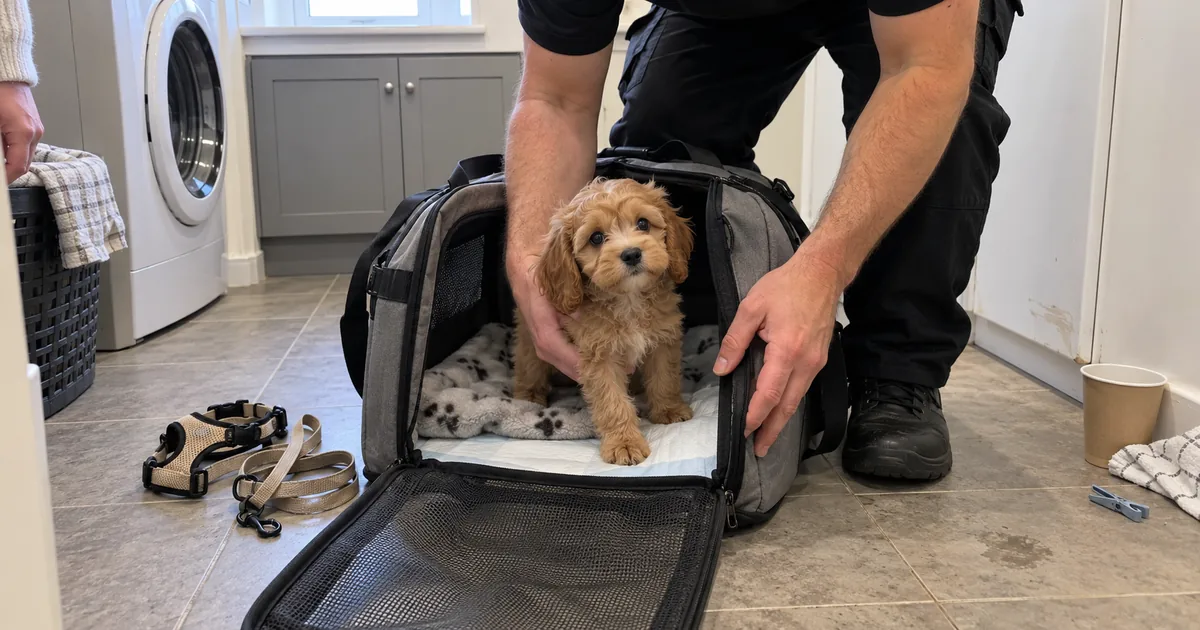
Is hiring someone else to bring your puppy home a good idea?
Yes, hiring someone else to bring your puppy home can be sensible when breeder checks are complete, the puppy is old enough and fit to travel, and the pet handler is authorised where the rules require it. Convenience comes last, after welfare, records and clear handover.
Most problems start before the vehicle leaves. A smooth collection plan cannot make a weak breeder look responsible, and a friendly seller can still be avoiding the checks you need. Distance is a real problem for many buyers, but it should never push the breeder out of view.
We look at puppy collection in three separate parts: who bred the puppy, who controls the trip, and what happens if the puppy is coming from abroad. Keep those separate and the decision becomes much easier to judge.
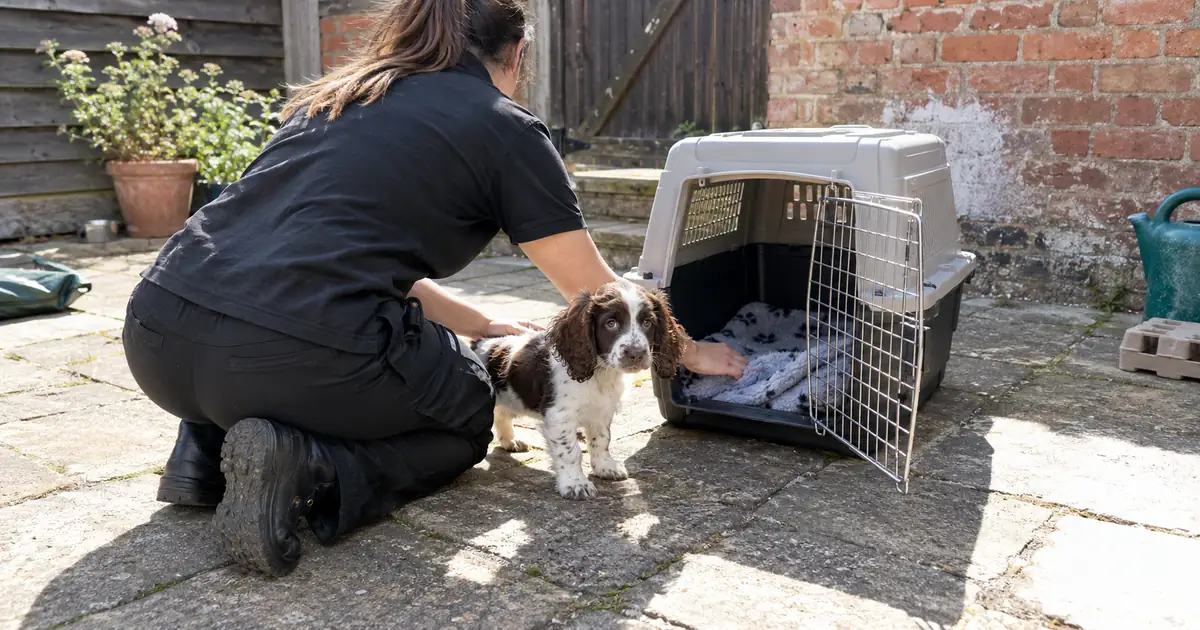
Spaniel Puppy Introduced to Travel Crate for Collection – Illustrative Image
Here's What We Have Covered In This Article
Check the breeder before transport is arranged
The real issue behind a puppy courier from breeder collection is trust. A safe puppy collection is a welfare and responsibility decision, not a parcel delivery. Before anyone collects the puppy, you need confidence in the breeder, the puppy’s age, the mother, the litter and the records.
Current GOV.UK buying guidance says anyone buying or adopting a puppy in the UK should deal directly with the breeder or a reputable UK rehoming centre. It also says you should ask to see the puppy with its mother and litter in its own home. That point matters because a third party collection can hide the very things you need to see before money and handover become final.
A responsible seller will never sell a puppy younger than 8 weeks old. If the breeder is licensed, their local authority animal activity licence number should be shown online, and the records should include medical details such as vaccination certificates and microchip records. Missing records or vague ownership history make breeder puppy collection weaker, even if the transport itself sounds organised.
A common warning sign is the seller who offers easy delivery but resists a home visit, pushes for a car park handover, or keeps the mother out of view. Genuine distance pressure is one thing. A seller avoiding scrutiny is another. Transport should follow breeder confidence.
Your collection choice decides who controls the trip
The right puppy collection option depends on who has control of the handover and how clearly the puppy’s care is managed in transit. We look at control first, because cost and convenience mean little if nobody can explain who has the puppy and what happens during travel.
The table below compares collecting the puppy yourself, breeder delivery, and using a professional pet handler.
| Collection option | What it gives you | Main caution |
|---|---|---|
| You collect the puppy | Direct breeder meeting and full handover control | Needs time, suitable transport, and a sensible plan for the trip |
| Breeder delivery | Convenience when the breeder is transparent | Can weaken buyer checks if agreed too early |
| Professional pet handler | Controlled door to door puppy transport with communication | Works well only when authorisation and welfare controls are clear |
Collecting the puppy yourself gives you the strongest view of the breeder and the handover. That can be hard if you do not drive, live far away, or cannot take the time needed. In that case, the answer to how to bring a puppy home if you do not drive is usually a choice between breeder delivery and professional puppy transport.
Breeder delivery can be fine when the breeder has already been checked and the trip is simple. A professional pet handler becomes more useful when distance, timing, vehicle suitability or communication during travel matter. The weak option is the one where custody feels vague.
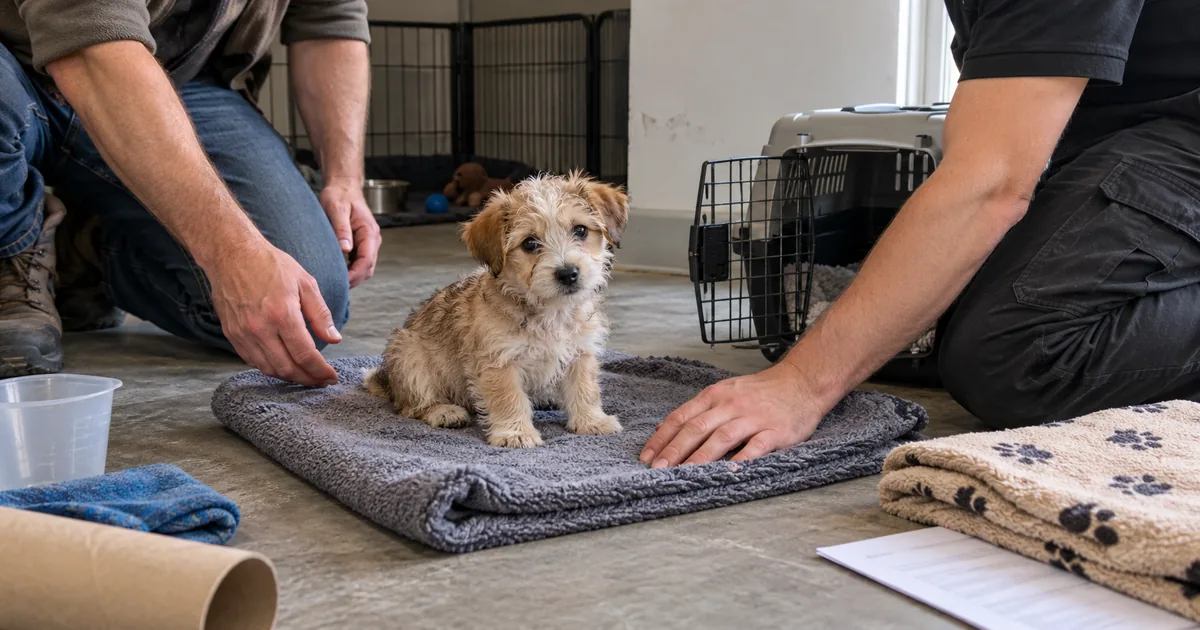
Young Terrier Puppy Beside Pet Travel Crate – Illustrative Image
Handling quality protects a young puppy
A young puppy with a long trip ahead can make two transport offers sound similar on the surface. One may be a general courier with pet wording on a page. The other may be an authorised pet transporter with trained handlers, suitable vehicle arrangements and a clear record of the trip.
Many buyers ask, does a pet courier need to be DEFRA licensed? The current official wording to look for is transporter authorisation. GOV.UK states that a commercial pet transport provider moving animals in Great Britain over 65km must have a UK issued transporter authorisation. The correct test is transporter authorisation and welfare competence, not a vague badge on a website.
Welfare during travel is a practical matter. The puppy must be fit to travel, checked for water, feed and rest needs, given enough floor space and height, and carried in a way that avoids injury or unnecessary suffering. Those are not decorative promises. They affect whether long distance puppy travel is suitable for that particular animal on that particular route.
Insurance has a place, but it tells you about financial cover. It gives no proof that the person collecting your puppy understands young animal welfare, route planning, monitoring or handover control. We want plain answers from the handler: who has the puppy, how the puppy is carried, how the trip is monitored and who speaks to you if timing changes.
With Tailored Pet Travel, we treat a young puppy move as welfare-led transport. The handler, vehicle conditions and communication have to match the puppy in front of us. That is the standard we think a safe pet courier for puppy collection should meet.
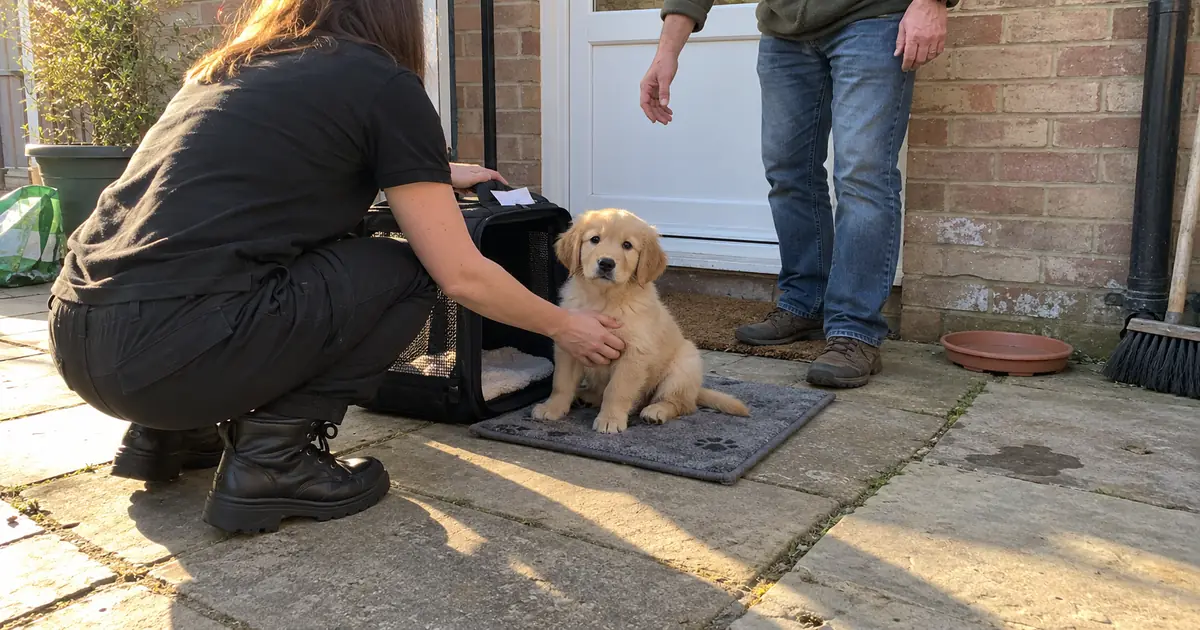
Golden Retriever Puppy Meeting Collection Handler at Home – Illustrative Image
Imported puppies need a different judgement
When the puppy is coming from abroad, the question changes. A puppy from abroad courier arrangement is no longer just a breeder to home collection, because overseas origin changes paperwork, ownership rules, route control and handover risk.
GOV.UK says that if a puppy is being brought into Great Britain from abroad for sale, transfer of ownership or rehoming, it is treated under commercial import rules. Normal pet travel assumptions may fit an owner travelling with their own pet, but a newly bought puppy is a different case. Very young imported puppy offers need careful scrutiny for that reason.
APHA, the Animal and Plant Health Agency, warns that a new pet imported into Great Britain for a new owner must be delivered directly to the declared destination. APHA also says collection from a public area such as a motorway service station or car park is against the law. A seller offering a motorway handover after import is giving you a compliance problem, even if the arrangement sounds convenient.
Overseas puppy collection can be handled properly by people who work with import rules and welfare controls every day. The buyer risk rises when the seller or courier presents a cross border puppy handover as simple delivery.
Choose the arrangement with clear responsibility
Once the breeder has been checked and the transport option makes sense, the final question is responsibility. We want to see a clear line from breeder to handler to destination, with records that match the puppy and communication that does not disappear once the puppy leaves the breeder.
GOV.UK says a commercial animal transporter must keep a written animal transport record. That record covers origin and ownership, place of departure, departure date and time, intended destination and expected travel duration. For a buyer, those details are useful because they show that the puppy handover has a custody trail.
Clear responsibility also matters if the trip is delayed or the puppy appears unwell on arrival. You need to know who had custody, what was recorded, and who was expected to act. A smooth promise at the start gives little comfort if the handover record is thin at the end.
This is where Tailored Pet Travel brings the decision back to control. We hold puppy transport together through welfare planning, clear custody and direct communication, so the move is treated as a live animal handover from start to finish. In puppy transport, proof of custody is the part that keeps responsibility visible.
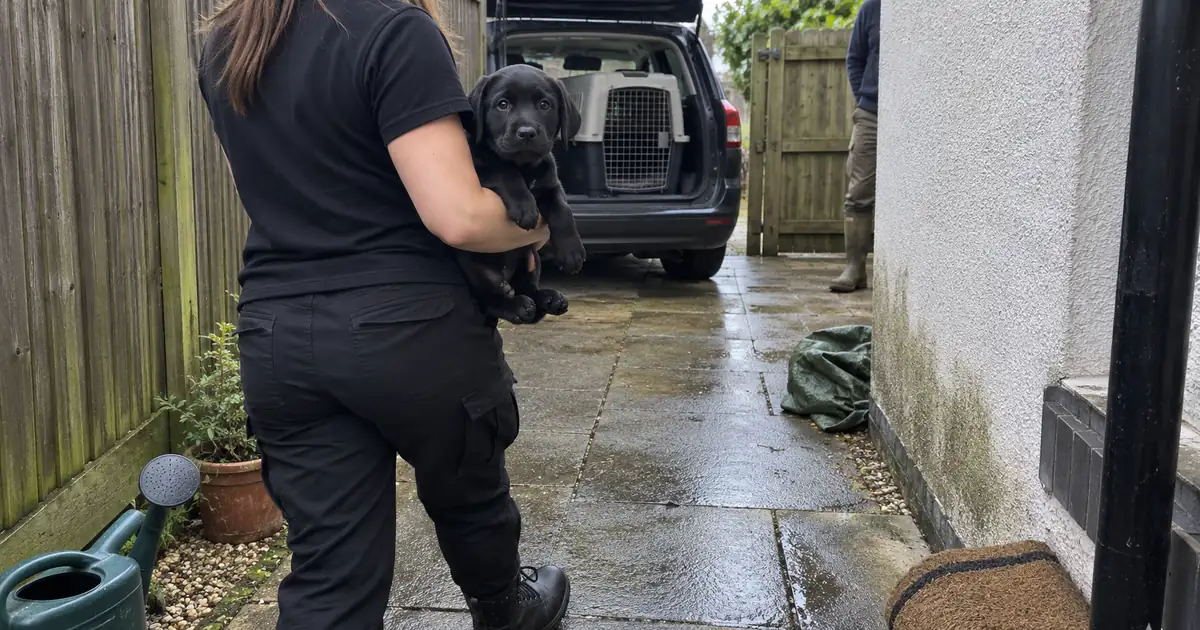
Black Labrador Puppy Carried Towards Pet Transport Vehicle – Illustrative Image
Questions people ask us about puppy collection from breeders
Can my puppy travel in a normal car?
A normal car can work for a simple family collection if the puppy is secure, supervised and comfortable. For a paid collection over distance, we would want a pet handler who can explain vehicle suitability and welfare monitoring in plain terms.
Can the handler send updates during travel?
Yes, a professional pet handler should be able to keep you informed during travel. Updates matter because they show that someone is actively managing the puppy, rather than treating the handover as a drop-off task.
What happens if the puppy seems unfit to travel on the day?
The move should pause until the puppy’s welfare is clear. A responsible handler will not treat timing as the main issue when the animal in front of them looks unwell or unsuitable for travel.
Is shared transport ever acceptable for a puppy?
Shared transport needs careful judgement because puppies are young, vulnerable and still settling after leaving the breeder. We look for clear separation, enough space, suitable handling and a route that does not put the puppy through avoidable strain.
Should the breeder know exactly who is collecting the puppy?
Yes, the breeder should know who is collecting the puppy and where the puppy is going. A vague collection arrangement weakens the handover and makes it harder for you to prove what happened if a problem appears later.