Should you pay for private air travel for your pet?
Yes, if private air travel reduces a real welfare, routing, breed, timing or handling risk. Taking your pet on a private jet can give more control over cabin supervision and timing, but route legality, paperwork and your pet’s fitness still decide whether the trip works for safety and border acceptance.
Most owners start with the cabin question: can my dog sit with me, can my cat avoid cargo, can several pets stay together? Those are fair questions. They just do not cover the whole risk.
Private pet travel earns its cost when it solves a problem that a normal route cannot handle well. A large dog, a refused airline booking, a tight relocation date or a complicated entry route can all change the answer. The spend needs to reduce a real risk, because a private aircraft still lands into the same world of documents, authorised carriers and pet checks.
We judge the choice by the whole movement from handover to arrival. That means the aircraft matters, but it sits alongside the route, the paperwork window, the operator and the animal’s condition on the day.
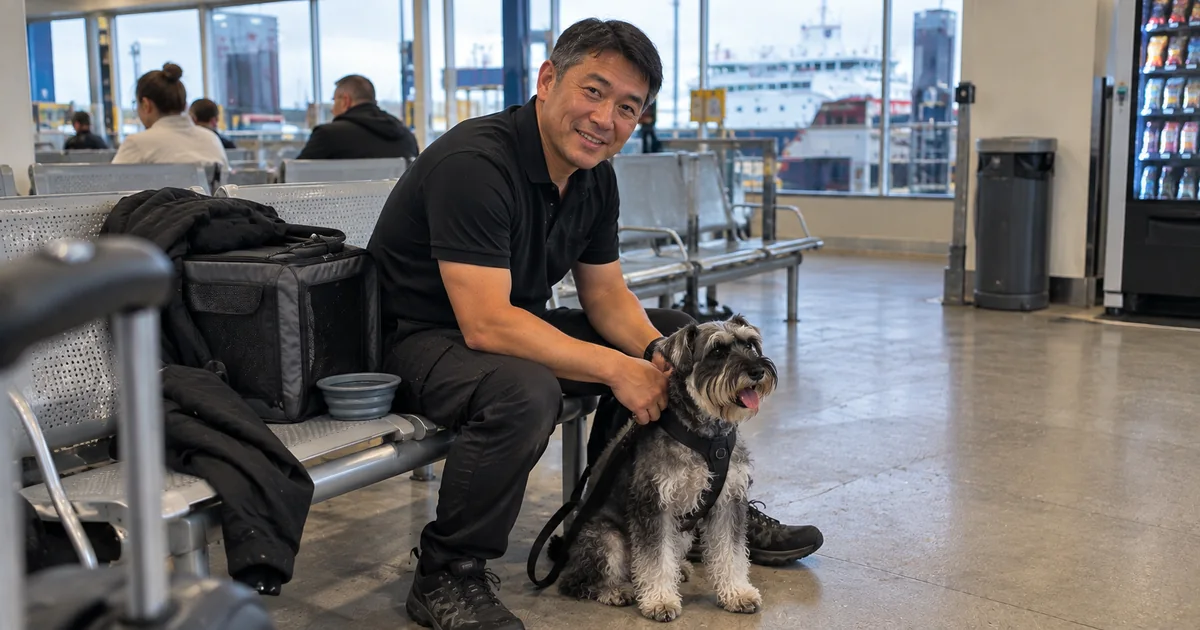
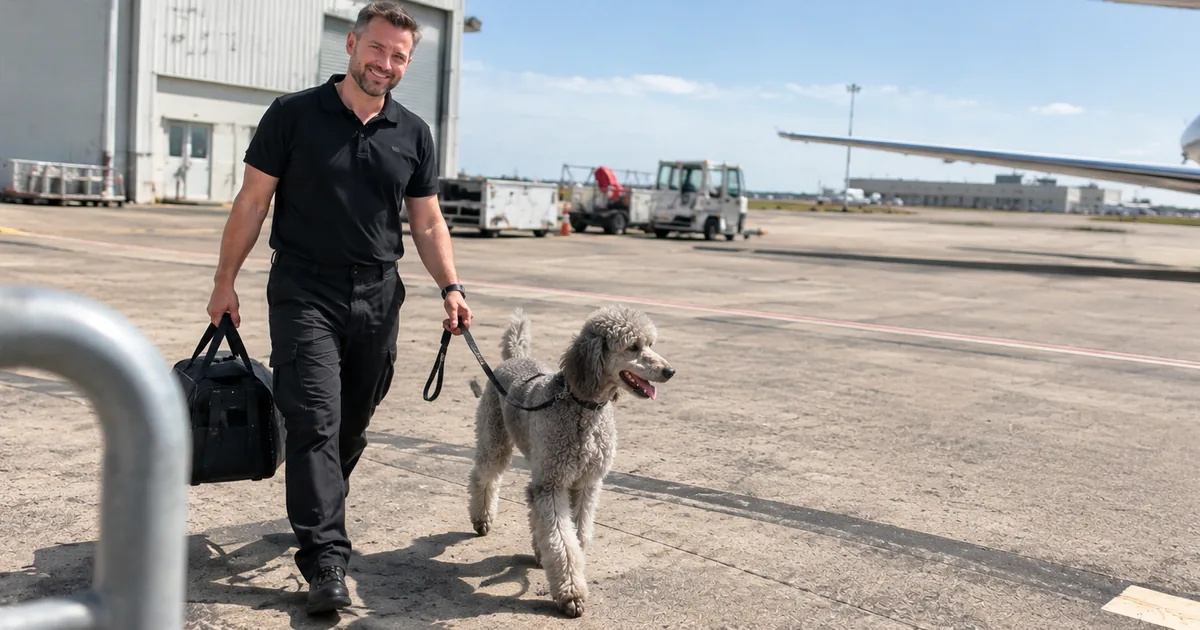
Dog waiting at airport with professional pet handler – Illustrative Image
Here's What We Have Covered In This Article
The aircraft is only part of the risk
A private aircraft can make the human side of travel feel simpler, yet your pet’s journey still has several hard points that no cabin layout can erase. A private jet can reduce some journey pressures, not remove the rules that decide whether the pet can travel.
For pets entering Great Britain, the route has to work through approved routes and an authorised carrier, apart from specific island and Ireland routes that sit outside that requirement. Sea and rail checks happen before departure to Great Britain, while air checks happen on arrival through authorised pet checkers. That route detail can matter as much as the flight itself.
At Tailored Pet Travel, we look at the full route before we judge whether the aircraft solves the problem. The Animal and Plant Health Agency sets the framework carriers work within, including a Required Method of Operation, which is the approved way carriers handle pet checks. That is why handover points, border checks and carrier acceptance belong in the same conversation as cabin travel.
Paperwork is the other hard edge. An Animal Health Certificate is the document used for many UK to EU journeys with dogs, cats and ferrets. It has a short window and must match the route. If the certificate, vaccination timing or pet presentation is wrong, the cost of the aircraft will not make the border checker wave it through.
Why a full charter can justify the cost
A full charter makes sense when the extra control solves a real travel constraint. Large dogs, several pets, tight timing, restricted routing or a pet that falls outside a normal airline option are the cases where we would examine it seriously.
Q3 2026 European private jet charter pricing starts at thousands of euros per block hour and rises sharply by aircraft class. Turboprops sit at about €2,100 to €4,600 per block hour, light jets at about €4,700 to €7,500, heavy jets at about €12,200 to €18,400 and ultra long range jets at about €14,300 to €22,500. A light jet routing such as London to Paris is listed from €8,300 all in, while long haul from Europe sits around €77,000 to €150,000 plus.
Cost moves because several parts of the flight move:
- Aircraft class: Bigger aircraft carry higher hourly costs and may be needed for range, space or route requirements.
- Block hours: Pricing follows the flying time the aircraft is committed to, which includes operational flying as well as the time you are on board.
- Route and repositioning: Aircraft availability and where the aircraft has to start or finish can change the final cost.
- Operational needs: Pet handling, airports, timing and owner travel all affect whether a charter plan is workable.
The value is control. You gain a dedicated aircraft, more flexibility over timing and a better chance of matching the flight to the animal’s handling needs. The same spend still has to sit behind a legal operator, a permitted route and the right pet travel documents.
For a straightforward small dog on an accepted airline route, a full charter is a large answer to a small problem. For a difficult pet move where a failed route would leave the animal stranded or the owner unable to travel, the calculation changes.

Dogs beside a private aircraft for luxury pet flight and relocation service – Illustrative Image
Shared pet charters need operator checks
A large dog may appear to have an available shared route, with a seat sold as part of a pet charter flight. The hidden question is simple: who legally operates the aircraft?
In the UK, a paid business jet or air taxi flight is commercial air transport. The UK Civil Aviation Authority says the ticket seller can be different from the operator, and passengers must be told the operator’s name so they can check the UK Air Operator Certificate list. An Air Operator Certificate is the approval that shows the operator is authorised for that type of commercial flying.
Shared pet charters can reduce the cost compared with paying for the whole aircraft. They also lock you into a route, date, cabin policy and aircraft type chosen for the shared flight. If your pet needs a different handover point or a different acceptance condition, the saving loses value.
We treat a shared pet charter as a transport service with three tests: legal operator, route fit and welfare fit. The seat only helps if the route and the animal match the flight being offered.
Alternatives can be the better welfare choice
Private air travel has a strong appeal when you want to avoid cargo, but the right option is the one that fits your pet and route cleanly. Commercial pet flights, road transport, Eurotunnel crossings and ferry routes all have a place. The weak choice is the one chosen for how it sounds, then forced around the animal later.
Four broad options cover most pet journeys, and each one carries a different kind of limitation.
| Option | Usually suits | Main limitation |
|---|---|---|
| Full charter | Complex pets, several pets, tight routing or large cabin needs | High cost and rules still apply |
| Shared charter | Owners who need cabin travel on a suitable shared route | Limited availability and operator checks |
| Commercial pet flight | Straightforward routes with airline acceptance | Airline rules, crate fit and route limits |
| Road, Eurotunnel or ferry | UK and Europe journeys where pacing matters | Longer journey and route dependent checks |
Commercial pet flights can be appropriate when the airline accepts the pet and the route is straightforward. IATA Live Animals Regulations are the standard used for transporting live animals by commercial airlines, and airlines and countries still set their own requirements. An IATA compliant container means the crate meets the live animal rules used for the journey, while the airline still decides acceptance.
Cargo deserves a fair assessment. It is a regulated transport route, and for some pets it is the cleanest way to move within airline rules. The question is whether the crate, route, temperature controls, airline policy and animal all fit together.
Road transport, Eurotunnel crossings and ferry routes are useful for many UK and Europe journeys, especially where pacing and direct handling matter. For longer paid road transport, Type 2 transporter authorisation is part of judging whether the operator is set up properly. We also take IATA’s warning on sedatives seriously: sedatives and tranquilisers are not encouraged for animals travelling in cabin or cargo because of possible adverse effects during transport.
A cheaper route can be the sounder route when it reduces the specific risk in front of you.
The right choice follows the pet and route
When a pet journey is difficult, start with the animal’s limits. Age, size, breed, health and previous travel tolerance all affect whether any air route is sensible. A private cabin can give supervision, but it cannot make an unfit pet fit to fly.
Route checks come next. Pets entering Great Britain can be stopped from travelling or entering if serious paperwork or presentation problems are found. Some animals, including F1 hybrid cats and dogs, cannot enter Great Britain under the normal pet travel rules and need a different route and approval position.
Paperwork has the shortest fuse. As of August 2026, GOV.UK says an Animal Health Certificate is valid for EU entry for 10 days after issue. Where a rabies vaccination is needed before EU travel, the owner must wait at least 21 full days after the first rabies vaccination, or the last dose of the first course, before getting that certificate. A charter cannot compress that waiting period.
One approach starts with the aircraft and tries to make the pet fit the plan. A stronger approach starts with the pet and builds the route around the risk that matters. At Tailored Pet Travel, we judge the route, documents and welfare before recommending private air travel, because an expensive aircraft still needs a compliant handover and a pet fit for the trip. The sound decision follows the pet and the route, not the status of the aircraft.
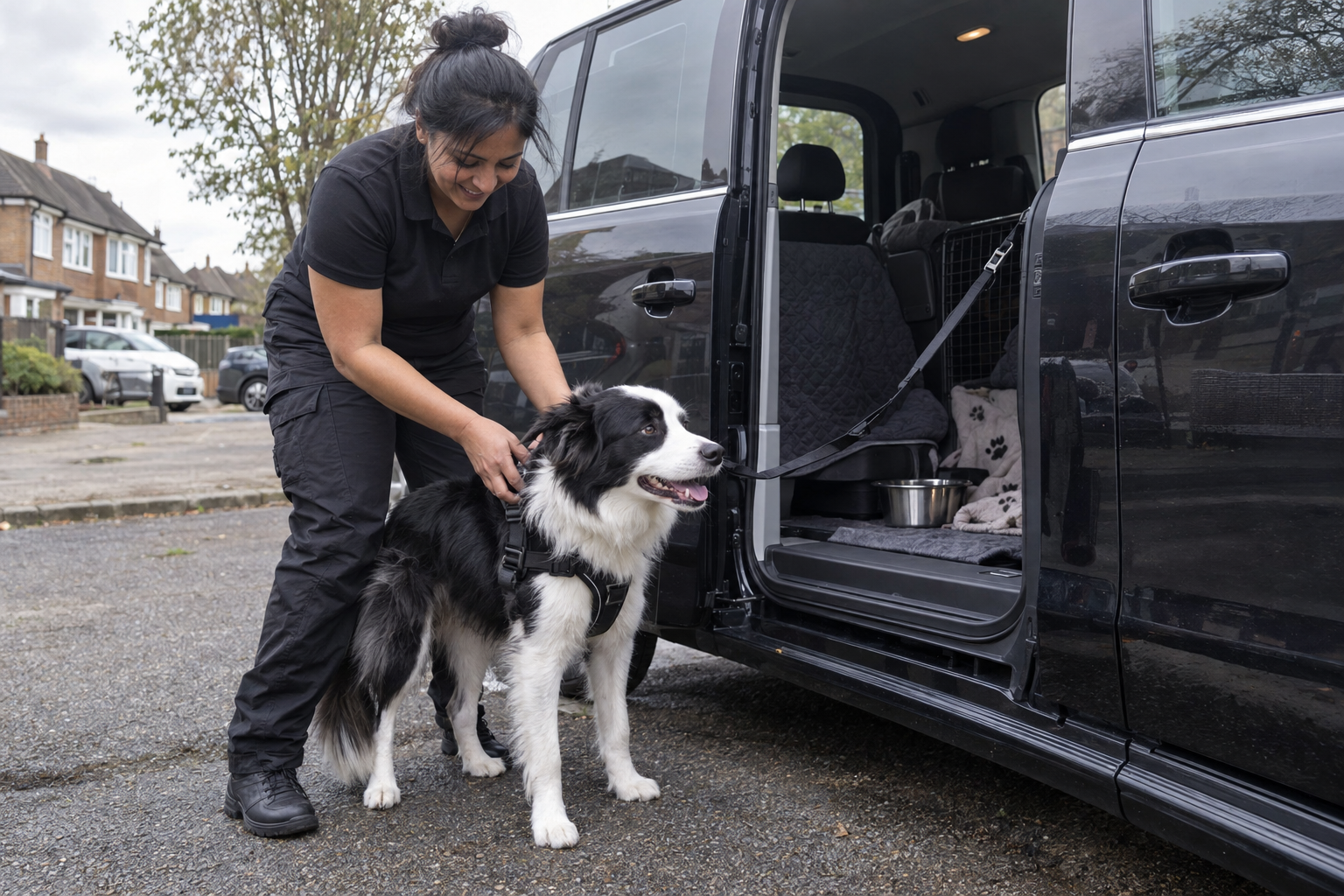
Border Collie harness check before pet transport
Questions pet owners ask us about private pet travel
Can my pet travel loose in the cabin on a private aircraft?
Cabin policy depends on the aircraft, operator and route. Some journeys allow closer supervision, but the pet still has to be handled in a way the operator and route accept.
Can one Animal Health Certificate cover more than one pet?
For travel from Great Britain or Northern Ireland to an EU country, GOV.UK says up to 5 dogs, cats or ferrets can be added to one Animal Health Certificate. The certificate still has to be correct for that trip and issued within the relevant window.
What if my pet has already been refused by an airline?
A refusal changes the risk picture. The useful starting point is the reason for refusal, such as crate fit, breed policy, route acceptance, timing or documents, because the next option has to solve that exact problem.
Can a snub nosed breed use private pet travel?
A snub nosed breed needs careful route and welfare assessment before any air plan is chosen. Private travel may give more control over handling, but the pet’s fitness and the operator’s acceptance still decide what is sensible.
Will the destination accept the same paperwork as the UK or EU route?
Destination rules can differ from the UK or EU position, and airlines can add their own acceptance requirements. The paperwork has to match the route being used, the carrier involved and the country your pet is entering.